
by Raden Yusuf Bahtimi bin Raden Haji Samsudin

Klewang or Palembang makara (RCIN 62200), photographed by Charles T Tompson
I was privileged to have the opportunity to view three weapons originating from the Palembang Sultanate in the British Royal Collection: a Palembang makara sword and two krises. I learnt about the sword for the first time from a Facebook post by Kemas C. Ibrani in the group he moderated, ‘Negeri Palembang’. I then exchanged private messages with him on 17 August 2023. Among other things, we discussed the high probability that the original owner of the sword was Suhunan Husain Dhiauddin (Raden Husain). This is what Kemas Ibrani told me:
Yes, it is most likely, because after the arrival of the British fleet, Sultan Mahmud moved his position upstream (uluan), leaving Susuhunan Husain Dhiauddin and Pangeran Nata Raja, if I’m not mistaken, and a few palace ministers to confront Britain. Gillespie only stayed for a few days in Palembang before returning to Batavia.
I pursued this further with the Royal Collection Trust (RCT), which now holds the sword. Francesca Levey, Arms and Armour Conservator, replied to my message, which resulted in my first visit to the conservation workshop at the Windsor Castle complex.
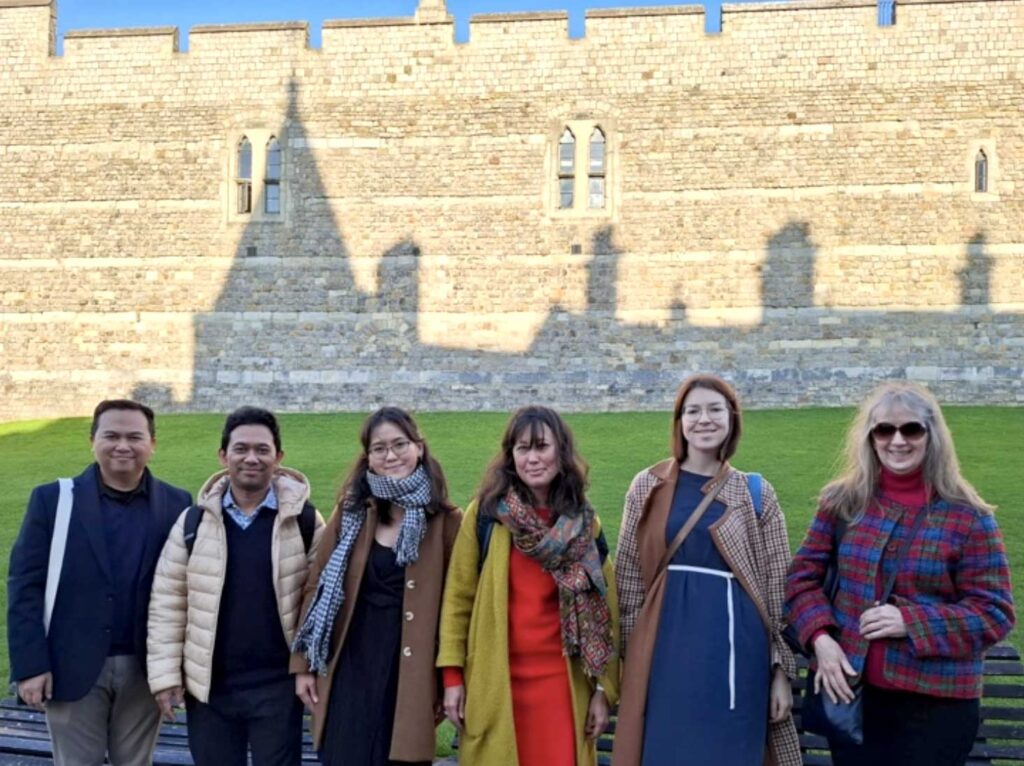
Naskah Sumatra team’s visit to Windsor (author at far left).
After sharing information about the sword with the Naskah Sumatra team, I visited the RCT for the second time.
During the two visits, I was able to observe the heritage of my family, a sword that was passed down from generation to generation – according to Major General Gillespie’s letter to Prince Regent in 1812–1813, which was shared by the RCT team (RCIN 62200). They also showed us a note that the sword was ‘sent to George IV when Prince Regent by the Sultan of Palembang’.
The letter by Gillespie mentions an assurance by the Sultan to Gillespie that the sword ‘… has been in his family for some Generations’. According to it, the item was sent from Java to England on October 1812 and arrived 8 months later (25 June 1813). The letter does not specify when Gillespie received the sword, nor mention the name of the Sultan he received it from. A letter from the Sultan, which might have accompanied the royal gift, has not been found. Gillespie’s letter also indicates that there were two items presented to the Prince Regent, a sword from Palembang and a kris from Yogyakarta (RCIN 62918). It mentions that one of them (the makara sword) is from the Sultan of Palembang, while the kris is from the Hamengkubuwono III, Sultan of Yogyakarta.
There is another relevant letter that has been found in the British Library by Mulaika Hijjas: an East India Company (EIC) document which mentions that Gillespie received a kris and a sword (klibang/klewang) from Pangeran Ratu of Palembang in 1811 (British Library MSS Eur E106). This raises further questions: Did Gillespie receive it from the Sultan himself? Might there have been another klewang (and kris) that was sent to Britain, or was this klewang the same item as the one described in the RCT inventory? Who was the Sultan who presented it to Pangeran Ratu? One possibility is Sultan Mahmud Badaruddin (Raden Hasan), which would suggest that Gillespie had visited Palembang before the British attacked in 1812. Another possibility is Sultan Ahmad Najamuddin (Raden Husain), which implies that Pangeran Ratu was still in Palembang during the attack. If the klewang was not the same object, where are the klewang and kris of Pangeran Ratu?
The inventory also came with a note:
Javanese, two edged barad [?unclear] blade [with?] water marks; embossed and filigree handle in pure gold in flowers, the handle takes the shape of the stem of a tree. The pommel forms the bud or leaves, on the oval part under the handle, but joining to it, are eight small stars of small stones and small diamonds mixed, with an additional two R [unclear] of red stones over and under the stars; black scabbard wound round with narrow stripes of leather. The upper part of the scabbard mounted with gold embossed flowers. The depth of the mounting 8 inches, small gold shape of oval form embossed with flowers to correspond.
This sword is a type known as klewang, while Palembang inhabitants would also recognise as a makara Palembang sword, where the hilt is carved in the form of makara. The makara in this case takes the shape of gajahmina (a mythical water creature: part elephant and part whale). The makara in this sword was highly stylised and takes form with three dimensional betel leaves (daun sirih) instead1 and a flower bud (most likely jasmine, rose, or lotus). The sophisticated carving in the hilt and upper part of the scabbard features betel leaves, bamboo shoot, and ferns. It also resembles Jawa demam, a figure hugging itself because of fever, a well known motif in kris hilts.
On my second visit to Windsor, I also had the opportunity to see two krises with typical Palembang ivory hilts. The first, brojol (straight), kris was, according to the RCT, part of Thomas Stamford Raffles’ collection which he presented to Prince Regent (later George IV) in May 1817 (RCIN 62913). The second kris, luk (curved), likely belonged to Prince Albert, Duke of Edinburgh (RCIN 67536). Both krises represents the two dhapur (blade form) commonly found in Palembang kris. The kris has a bird’s head/Jawa demam shaped hilt/handle, while the warangka (scabbard) is gold plated with a gemstone (possibly diamond) just below the handle. Similarly to the sword, floral motifs are found on both krises’ warangka.
In 2024, Indonesia and the UK celebrated the 75th anniversary of their bilateral relationship, but this relationship dates back to much earlier times. Indonesia’s rich flora and fauna, which was among the reasons for European expeditions to the Indian Ocean, finds its material manifestations in the three items that are now housed in Windsor. These items are witness to the relationship between the two countries that existed long before Indonesia was established as a nation state. For me, holding the sword was a connection to my forebears, a truly meaningful experience.
Footnote
- Cek Heri Sutanto, kris and sword scabbard craftsman from Palembang. In our communication he noted that climbing plants (daun sulur) were among most common flora motifs used for swords produced in Palembang. Agus Susatya in our conversation on November 2023 also agreed that the motif likely represents betel leaf.
Yusuf Bahtimi Samsudin is a PhD candidate at the Queen’s College, University of Oxford.
